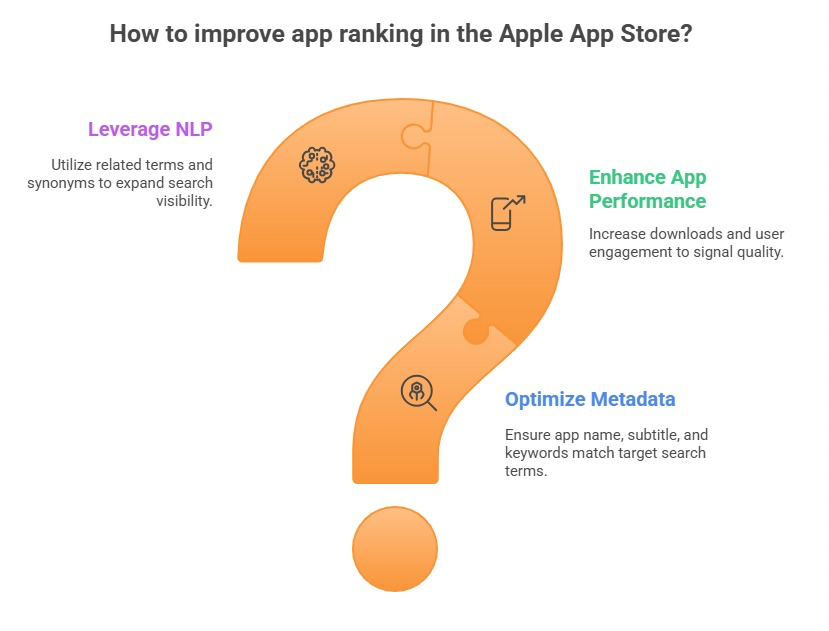
A new app usually becomes searchable by its name within hours to a few days of release, starts ranking for less competitive keywords within a few weeks, and needs months of downloads, ratings and conversion improvements to rank for competitive terms. Rankings fluctuate early. You can speed things up with relevant metadata, a strong launch spike, early ratings and paid search that drives real users.
When a new app appears in search
After release, both stores index the app’s metadata. Searching the exact app name usually finds it within hours to a few days. If it does not appear after several days, check that it is available in that country and that the name matches what you search.
Our App Store keyword field and Google Play keyword optimization guides explain what gets indexed.
The first few weeks
In the first weeks, the stores test the app for many searches and watch how users respond. Rankings jump around as the algorithm learns. Less competitive, long-tail keywords are where a new app can rank first.
See our long-tail app store keywords guide.
Competitive keywords take months
Broad keywords like “photo editor” or “budget app” are dominated by apps with years of downloads and ratings. Ranking for them takes sustained installs, conversion and engagement.
Build up from long-tail terms toward broader ones, tracking progress with keyword ranking tracking.
What speeds up ranking
Relevant metadata, a high conversion rate, a concentrated launch spike, early positive ratings and retention all help. Apple Ads and Google App Campaigns can drive real installs that add to momentum.
Read App Store ranking factors for what the stores weigh.
Why rankings fluctuate
Rankings move with competitor updates, seasonal demand, algorithm changes and your own release cycles. Daily movement is normal; judge trends over weeks.
Annotate changes so you can tell which actions moved rankings.
Updates and rankings
Metadata changes on the App Store need a new version, so plan keyword updates with releases. Google Play re-indexes listing text without an app update.
See app update frequency and rankings.
What not to do
Buying installs, fake reviews or keyword stuffing can get an app penalised or removed. They also attract users who leave quickly, which hurts rankings.
Our white hat vs black hat ASO guide explains the rules.
A realistic timeline
Expect name searches within days, long-tail rankings within two to six weeks, and meaningful gains on competitive terms over three to six months of steady improvement.
If progress stalls, run an ASO audit to find the constraint.
Differences between the App Store and Google Play
On the App Store, keywords come from the app name, subtitle and keyword field, and changes need a new app version. On Google Play, the title and descriptions are indexed and listing text can change without an app update.
This means Google Play keyword tests can run faster, while App Store changes should be planned with releases. See iOS vs Android ASO.
Country by country
Rankings are separate in each country. An app may rank quickly in a small market and slowly in a large, competitive one. Localized metadata helps each market rank on its own terms.
Track rankings per country rather than relying on one market as a signal for all.
Ranking for your brand name
Ranking first for your own app name should happen quickly. If another app outranks you for your name, check that the name is distinctive, that it appears in your title, and that early users search and install by name.
Our app title naming strategy guide covers brand and keyword balance.
When to get help
If rankings stay flat after several months of updates, an outside review can spot problems in keyword choice, conversion or ratings that are hard to see from inside the team.
An ASO audit is a good first step.
A worked example: a new budgeting app
A budgeting app launches in the US. Its name appears in search within a day. It targets long-tail terms such as budget planner for couples and expense tracker shared, and ranks in the top ten for several within five weeks.
Apple Ads on those terms adds installs, and a rating prompt after the first saved budget lifts its rating. After four months, it reaches the top 50 for budget app, a broad term it could not touch at launch.
Measuring ranking progress properly
Track a fixed list of keywords per country weekly, along with search impressions and conversion. Rankings alone can mislead, since a high rank for an irrelevant term brings no installs.
Focus reporting on installs from search and conversion rate, using rankings to explain why they change.
Category rankings versus keyword rankings
Top charts in a category reflect recent downloads and other signals, while keyword rankings reflect relevance and performance for specific searches. A new app can rank well for keywords without appearing in charts, and a launch spike can briefly push it into charts.
Both matter, but keyword rankings usually bring more steady installs for new apps. Choose your app category carefully, since a less crowded category can make charts more reachable.
Patience with metadata changes
After a metadata change, wait two to four weeks before judging results, since indexing and user response take time and weekly noise is high.
Change one major element at a time where possible, so you can tell which change helped.
How to do it, step by step
- Confirm indexingSearch your exact app name in each target country.
- Target long-tail keywords firstPick relevant, less competitive terms.
- Drive a launch spikePre-registrations, PR, creators and search ads.
- Collect early ratingsPrompt satisfied users at success moments.
- Track and iterate monthlyUpdate metadata and creatives based on data.
Before and after examples
Illustrative examples written for a generic app in this category, not client results. Swap in your own product, audience, and data.
Only broad keywords.
Ten long-tail keywords plus two broad goals.
Why it works: Early wins build momentum.
Top 10 for a broad term in two weeks.
Long-tail top 10 in six weeks; broad terms over months.
Why it works: Realistic goals guide decisions.
No rating prompt.
Prompt after first completed task.
Why it works: Early ratings lift conversion and ranking.
Action plan
- Check indexing early
- Win long-tail terms first
- Create a launch spike
- Collect early ratings
- Track trends weekly
- Avoid shortcuts
Metrics to monitor
- Keyword rankings by term
- Impressions from search
- Conversion rate
- Ratings count and average
- Retention
Record the baseline, release date, audience, markets, and external changes before interpreting movement. Rankings and conversion are useful signals, but a decision is stronger when activation, retention, and business value confirm that the page attracted the right users.
Frequently asked questions
How long does it take for a new app to show up in search?
Usually hours to a few days for searches of the exact app name.
Why isn't my new app ranking?
Common causes are low relevance, competitive keywords, low conversion and few ratings.
How long does ASO take to work?
Long-tail gains often appear in weeks; competitive keywords take months.
Do updates help rankings?
Regular updates and metadata improvements can help, especially when they improve conversion.
Can paid ads help a new app rank?
Real installs from paid search can add momentum, but relevance and conversion still decide rankings.
Should I change keywords often?
Give changes a few weeks to show results before changing again.
Keep reading
More in Keyword Strategy
Browse all 15 Keyword Strategy guides