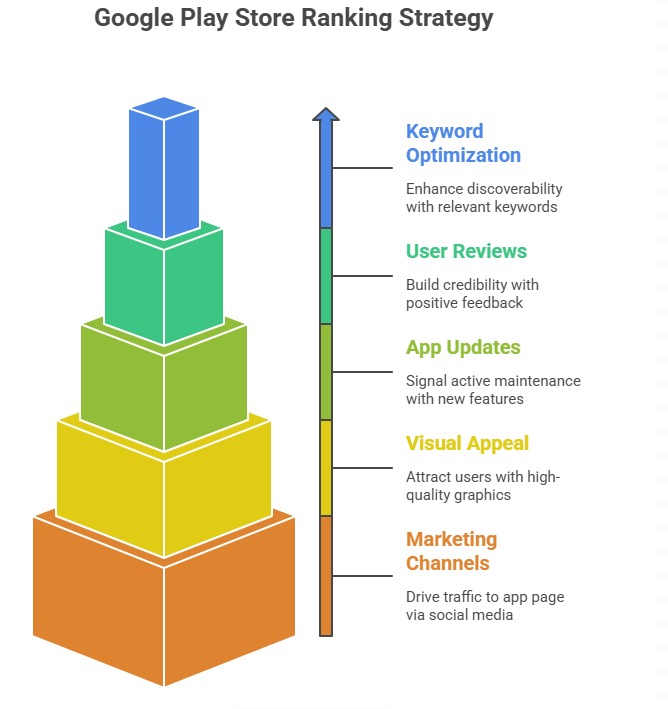
Quick answer: Google Play keyword optimization means describing an app's purpose, features, audience, and benefits in clear language that users understand and that accurately represents the product. Use the title and descriptions to cover a coherent topic naturally. Repeating a phrase to hit a density target damages readability and can create policy or spam risk; relevance, persuasion, and product quality are the stronger strategy.
What this guide will help you do
This guide focuses on Google Play keyword optimization with a practical, evidence-led approach. It covers Play Store keywords, Google Play ASO, Play Store description optimization without repeating phrases for artificial density. Use the framework to make a clear decision, document the result, and improve the next release.
Create a message hierarchy before writing
Define the one promise the listing must communicate, then arrange supporting features and proof beneath it. The title identifies the product, the short description earns attention, and the full description resolves questions. This hierarchy prevents a list of keywords from replacing a coherent value proposition.
Build a semantic brief containing core problem, primary outcome, key capabilities, audience language, trust signals, and exclusions. Writers can then cover the topic completely without awkward repetition.
Write for scanning and comprehension
Open with the user's problem and the app's concrete solution. Use short sections and descriptive headings to explain how it works, who it helps, and why it differs. Replace vague claims such as 'best' with verifiable capabilities, workflow details, or credible proof.
Important language should appear where it helps a reader. Synonyms and related concepts can make the explanation more complete, but variation should not distort product terminology. Read the copy aloud: repeated phrases and robotic transitions become obvious.
Connect text to visual evidence
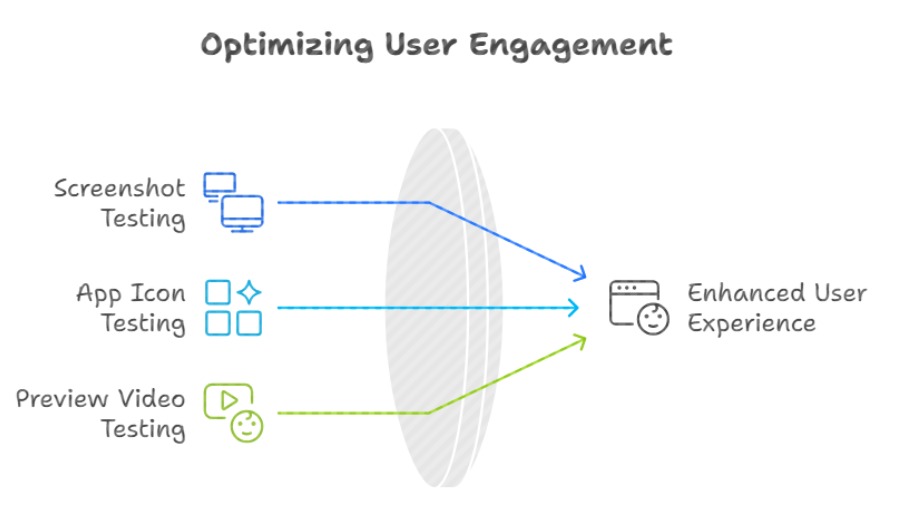
The icon and feature graphic create recognition, while screenshots should demonstrate the promise in sequence. If the description leads with automatic expense capture, the first assets should show capture, categorization, and the resulting insight—not an unrelated dashboard.
Use custom store listings when audience, country, search keyword, or campaign intent warrants a tailored message. Each variant should preserve truthful positioning while changing the most relevant feature, proof, or creative order.
Measure qualified growth
Monitor store-listing visitors, acquisitions, conversion, search terms where available, country, language, and acquisition source. Pair those results with uninstall, crash, retention, and revenue signals. A listing that increases installs but attracts the wrong users is not an ASO win.
Change one strategic variable at a time and use store listing experiments for material creative questions. Document the hypothesis, audience, primary metric, guardrails, run dates, and final decision.
Action plan
- Write a one-sentence positioning statement
- Cover problem, outcome, capabilities, audience, and proof
- Remove density targets and forced repetition
- Mirror the promise in the first screenshots
- Segment listings when intent differs
- Measure installs with quality guardrails
Metrics to monitor
- Store listing visitors by search and explore
- Acquisition and conversion rate
- Performance by country and language
- Uninstall, retention, and revenue guardrails
Record the baseline, release date, audience, markets, and external changes before interpreting movement. Rankings and conversion are useful signals, but a decision is stronger when activation, retention, and business value confirm that the page attracted the right users.
Continue the topic cluster
Use these supporting resources to move from this strategy into the next implementation step:
- ASO Keyword Research: A Step-by-Step Framework That Finds Install Intent
- Google Play Store Listing Experiments: A Practical Testing Playbook
- Google Play Console Store Performance: Read the ASO Funnel
- App Store Conversion Rate Optimization: Turn More Visitors Into Installs
- App store optimization services
- Creative A/B testing services
Frequently asked questions
Is there a recommended keyword density for Google Play?
No reliable universal density target exists. Write complete, accurate, useful copy and place important concepts naturally. Forced repetition can hurt comprehension and trust.
Does Google Play index the long description?
The listing text helps Google understand the product, but teams should not reduce optimization to field indexing. A coherent page and strong product outcomes are more durable than formulaic placement.
How long should a Play Store description be?
Long enough to answer the user's important questions and no longer. Use available space when the product needs explanation, but do not pad the page with repetitive copy.
Primary sources
Platform capabilities and limits can change. Verify current requirements in these official resources: