Quick answer: App store optimization (ASO) is the ongoing process of improving an app's discoverability and conversion rate in Apple App Store and Google Play. Strong ASO connects search demand with relevant metadata, persuasive product-page creative, trustworthy ratings, localized messaging, and a measurement loop. It is not a one-time keyword edit: rankings and installs improve when relevance, conversion, and product quality reinforce one another.
What this guide will help you do
This guide focuses on app store optimization with a practical, evidence-led approach. It covers ASO guide, app store SEO, improve app visibility without repeating phrases for artificial density. Use the framework to make a clear decision, document the result, and improve the next release.
How ASO creates compounding organic growth
ASO has two jobs. First, it helps a store understand which searches and browsing contexts match the app. Second, it helps the right visitor decide to install. Treating visibility and conversion as one system prevents a common failure: ranking for broad terms that attract low-intent visitors and weaken conversion.
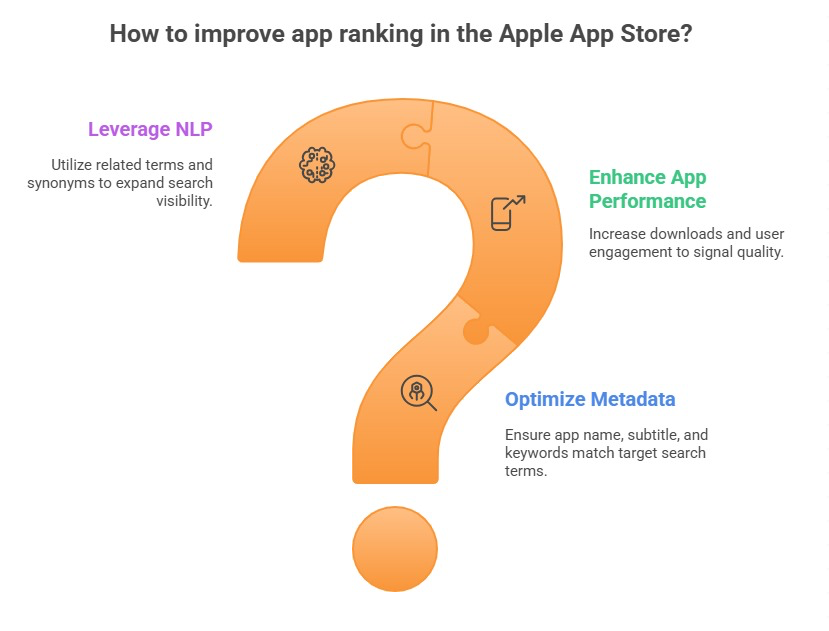
The practical loop is research, prioritize, ship, measure, and learn. Keyword and category research reveals demand; metadata earns relevance; screenshots and video communicate value; ratings reduce perceived risk; retention confirms that the promise matched the product. Each release should turn those signals into the next hypothesis.
Apple App Store versus Google Play
Apple explicitly describes search as using text relevance—including title, keywords, and primary category—alongside customer behavior such as downloads and the quality and quantity of ratings and reviews. The compact iOS metadata fields make prioritization essential: every term must support a real use case.
Google Play provides more indexable listing copy and emphasizes a complete, accurate, policy-compliant product story. Its title, short description, long description, tags, creative assets, and product quality should express the same positioning without mechanical repetition. Write for comprehension first, then verify that important concepts appear naturally.
A durable ASO operating model
Build one source of truth containing target audiences, jobs to be done, market vocabulary, proof points, objections, and brand rules. From it, create platform-specific metadata and creative hypotheses. This keeps paid campaigns, store listings, onboarding, and product messaging aligned while allowing each storefront to use its own native features.
Review performance by market and acquisition source, not only as a global average. A creative can win in one country and lose in another; a keyword can drive installs but poor retention. Decisions should combine impressions, product-page views, conversion, first-time downloads, quality signals, and downstream value.
What to do in the first 30 days
Week one is diagnosis: benchmark rankings, conversion, ratings, competitors, and localization coverage. Week two is strategy: select priority audiences and build a keyword-to-message map. Week three is production: prepare metadata and one focused creative test. Week four is launch and instrumentation: annotate changes, monitor leading indicators, and protect enough time for a reliable read.
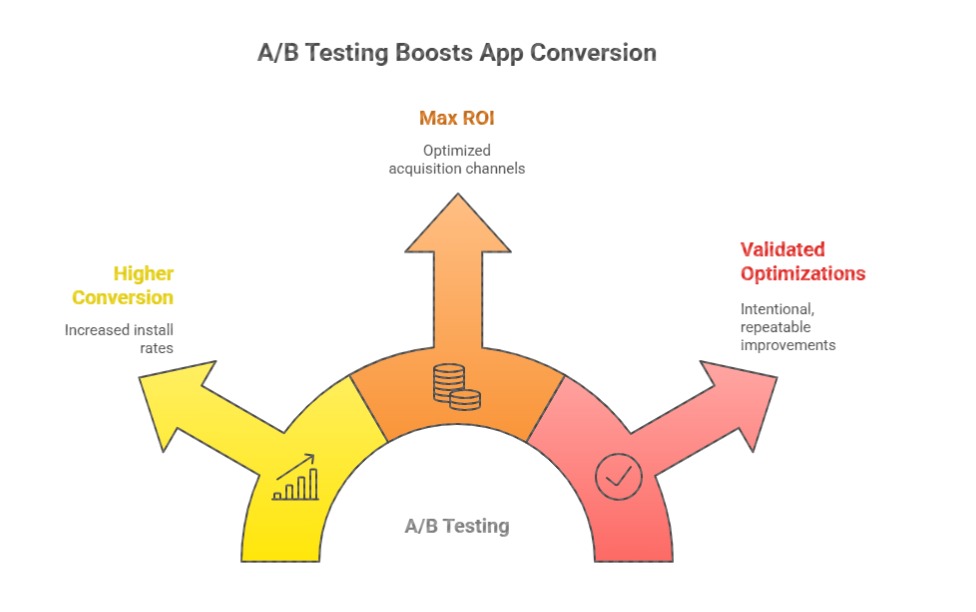
Do not change every variable together. A disciplined cadence preserves learning. Start with the largest evidence-backed bottleneck, define a success metric and guardrails, ship one coherent treatment, and record what the result changes about your customer understanding.
Action plan
- Define one primary audience and job to be done per storefront
- Map high-relevance search themes before choosing individual terms
- Align the first three screenshots with the search promise
- Localize meaning and proof, not just words
- Measure conversion and post-install quality together
- Document every release and test result
Metrics to monitor
- Search impressions and keyword coverage
- Product-page conversion rate
- First-time downloads by source and territory
- Rating quality, crashes, retention, and revenue guardrails
Record the baseline, release date, audience, markets, and external changes before interpreting movement. Rankings and conversion are useful signals, but a decision is stronger when activation, retention, and business value confirm that the page attracted the right users.
Continue the topic cluster
Use these supporting resources to move from this strategy into the next implementation step:
- ASO Keyword Research: A Step-by-Step Framework That Finds Install Intent
- App Store Conversion Rate Optimization: Turn More Visitors Into Installs
- ASO Audit Checklist: Find the Highest-Impact Growth Constraint
- ASO KPIs: The Metrics That Connect Visibility to Revenue
- App store optimization services
- Creative A/B testing services
Frequently asked questions
How long does ASO take to work?
Metadata can be re-evaluated after a release, but dependable growth usually requires several learning cycles. Timing varies by store, market, app history, traffic, and the size of the change. Judge progress with leading indicators while protecting long-term retention and value.
Is ASO the same as SEO?
They share research, relevance, and conversion principles, but the ranking systems, fields, assets, and analytics differ. ASO focuses on app-store discovery and install conversion; web SEO focuses on search-engine crawling, indexing, and page usefulness.
Should every app target high-volume keywords?
No. Relevance and attainability matter more than volume alone. A smaller query that closely matches the product can produce better conversion, retention, and ranking momentum than a broad term with weak intent.
Primary sources
Platform capabilities and limits can change. Verify current requirements in these official resources: