Quick answer: Google Play store listing experiments help teams compare listing assets or copy with a control. The strongest program tests a substantial customer insight, changes a controlled variable or coherent concept, accounts for traffic and seasonality, and applies only results that are statistically and commercially meaningful. Retention and value should remain guardrails.
What this guide will help you do
This guide focuses on Google Play store listing experiments with a practical, evidence-led approach. It covers Play Store A/B testing, store listing test, Google Play creative testing without repeating phrases for artificial density. Use the framework to make a clear decision, document the result, and improve the next release.
Create an experiment backlog from evidence
Collect barriers from reviews, surveys, support, competitor analysis, and funnel data. Turn them into hypotheses such as: leading with automatic setup will improve conversion for time-poor users because current creative makes onboarding look manual.
Score ideas by expected impact, confidence, reach, production effort, and learning value. Maintain separate backlogs for global defaults, important markets, and campaign-specific listings.
Choose the right scope
Test one meaningful element when attribution matters, or one coherent creative route when evaluating a full positioning concept. Avoid treatments that mix a new promise, new audience, new colors, and new proof without a clear reason.
Check whether active campaigns, featuring, major releases, or seasonal events will alter the visitor mix. Run tests in representative periods and document unavoidable confounders.
Interpret the result as a range
Use the experiment report rather than reacting to daily swings. Consider the estimated effect, uncertainty, sample, and practical value. A small apparent lift can reverse, and a statistically clear lift may still be too small to justify operational complexity.
Review market and acquisition segments when available, but avoid slicing data until a convenient winner appears. Segment hypotheses should be planned in advance and confirmed with further evidence.
Scale learning with custom listings
A global loser can be a local winner when intent differs. Google Play custom store listings can target audience segments such as country or region, ads traffic, pre-registration, lifecycle state, and—in supported configurations—search keywords and custom audiences.
Apply the lesson to the appropriate page, monitor post-launch performance, and store the assets and conclusion in a searchable test library. Re-testing old assumptions is reasonable when product or audience conditions change.
Action plan
- Source hypotheses from real customer barriers
- Predefine primary metric and guardrails
- Control traffic and seasonal noise
- Judge practical as well as statistical value
- Use custom listings for genuine segment differences
- Archive every result, including losses
Metrics to monitor
- Acquisition and conversion uplift
- Confidence interval or reported uncertainty
- Incremental installs by market
- Uninstall, retention, and revenue guardrails
Record the baseline, release date, audience, markets, and external changes before interpreting movement. Rankings and conversion are useful signals, but a decision is stronger when activation, retention, and business value confirm that the page attracted the right users.
Continue the topic cluster
Use these supporting resources to move from this strategy into the next implementation step:
- Google Play Console Store Performance: Read the ASO Funnel
- App Store Conversion Rate Optimization: Turn More Visitors Into Installs
- App Store Screenshot Design: A Storyboard That Converts
- Google Play Keyword Optimization Without Keyword Stuffing
- Creative A/B testing services
Frequently asked questions
What should be tested first on Google Play?
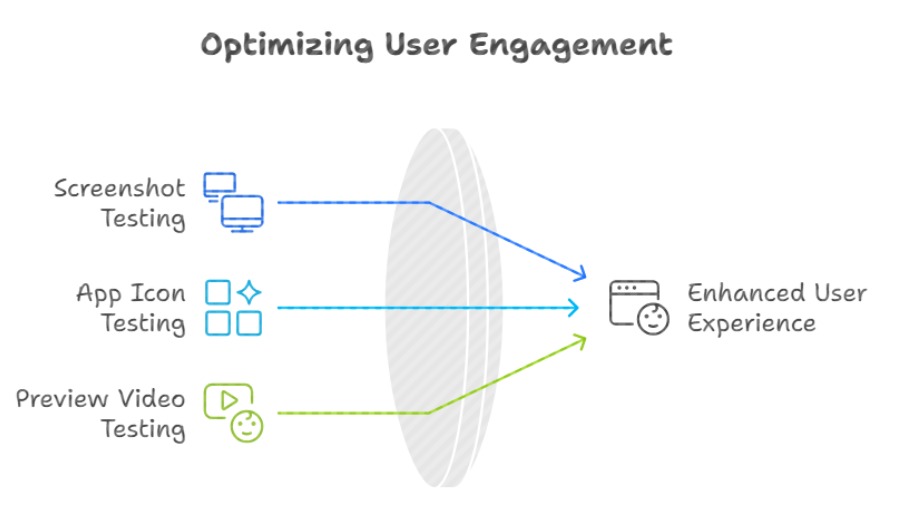
Start with the highest-impact unresolved barrier. That may be an icon, first screenshot, feature graphic, or message—not necessarily the easiest asset to produce.
Can several assets change in one treatment?
Yes, when the goal is to test one coherent concept. If you need element-level attribution, isolate the important variable.
Should every positive result be applied?
No. Check uncertainty, absolute incremental value, segment consistency, production cost, policy compliance, and post-install quality.
Primary sources
Platform capabilities and limits can change. Verify current requirements in these official resources: