Introduction
Most teams start their ASO keyword strategy with the biggest, broadest terms in their category. Everyone wants to rank for the single word that describes what their app does. The problem is that everyone else wants that too, and the apps already sitting at the top usually have years of install history, reviews, and brand recognition behind them.
Long-tail keywords take a different approach. Instead of chasing one high-volume term, you target dozens or hundreds of longer, more specific phrases that individually bring smaller amounts of traffic but collectively add up to something much larger, and often convert better along the way.
At ASOWin, long-tail keyword strategy is one of the fastest ways we help newer or mid-sized apps build real organic momentum without needing to out-muscle category leaders on day one.
Short Answer: How Do You Rank for Long-Tail Keywords?
You rank for long-tail keywords by mining specific, lower-competition phrases from user reviews, competitor listings, and search suggestions, then weaving them naturally into your app's title, subtitle, keyword field, and description. Because long-tail terms face far less competition than broad head terms, apps with modest install histories can often rank for them within weeks rather than months, and the combined traffic frequently outperforms chasing a single high-volume keyword.
Why Long-Tail Keywords Compound Over Time
A single long-tail phrase like "habit tracker for students" might only get a fraction of the searches that "habit tracker" gets. But that phrase also has a fraction of the competition, meaning a well-optimized listing has a realistic shot at ranking near the top. Multiply that by fifty or a hundred similar phrases spread across your metadata, and the cumulative traffic can meaningfully exceed what a single broad term could ever deliver for a mid-sized app.
There is also a conversion advantage. Someone searching a specific, descriptive phrase already has a clearer idea of what they want, which usually means a higher install rate once they land on your listing. This is part of why our keyword installs service treats long-tail coverage as a core growth lever, not an afterthought squeezed in after the "important" keywords are handled.
The compounding effect also shows up in a way many teams underestimate: stability. Head terms are contested constantly, and a single competitor's redesign or a new market entrant can knock you out of a hard-won position overnight. Long-tail rankings tend to be stickier because fewer apps are actively fighting for the same specific phrase. A portfolio built on dozens of long-tail wins is naturally more resilient to competitive shocks than a strategy resting entirely on two or three broad terms.
New apps benefit from this dynamic the most. A brand-new listing with no review history and minimal install volume has almost no realistic path to outrank an established leader for a broad category term in the first few months. Long-tail phrases give that same new app a genuine entry point, a way to start earning organic installs, reviews, and ranking signals that eventually build toward competing for bigger terms later.
Mining Long-Tail Keywords From User Reviews
Reviews are one of the richest, most underused sources of long-tail keyword ideas. Real users describe your app in their own words, not the marketing language your team uses internally. A fitness app might be described internally as a "workout tracking platform," while reviews reveal users searching for phrases like "app to track home gym workouts" or "simple workout log without a subscription."
Reading through your own reviews, and just as importantly your competitors' reviews, surfaces the actual vocabulary real searchers use. Complaints are especially valuable here: when users say a competitor app is "too complicated for beginners," that is a strong signal that a long-tail phrase like "beginner-friendly" paired with your category term could be a real opportunity.
Mining Long-Tail Keywords From Competitor Listings
Competitor listings reveal long-tail opportunities in a different way. Rather than reading what competitors say about themselves, look at what they are missing. If three major competitors in your category all optimize around a handful of broad terms but none of them mention specific use cases, audiences, or feature combinations that your app happens to support well, those gaps are long-tail keyword opportunities sitting untouched.
This is a deeper version of the gap analysis covered in our guide to keyword research tools for ASO, where competitor keyword overlap data helps identify exactly which phrases are contested and which are open.
It is worth looking beyond your direct competitors too. Apps in adjacent categories that share some of your audience, even if they solve a different core problem, often reveal long-tail phrasing patterns worth borrowing. A meditation app might learn useful long-tail structures from how sleep apps describe their audience, even though the two apps are not direct rivals for the same head terms.
Mining Long-Tail Keywords From Search Suggestions
Both the App Store and Play Store offer autocomplete suggestions as users type into the search bar. These suggestions are a direct window into real search behavior because they are generated from actual aggregate query data, not guesswork. Typing your app's core category term and noting every suggestion that appears is one of the simplest, fastest ways to build a long-tail keyword list.
Pay attention to modifiers that show up repeatedly: words like "free," "offline," "for beginners," "no ads," or specific demographic and use-case qualifiers. These modifiers often reveal entire clusters of long-tail phrases worth testing in your metadata.
It also helps to search from multiple starting points rather than a single core term. Try your app's category term, your top two or three feature names, and common problem statements your app solves. Each starting point tends to surface a different cluster of suggestions, and combining all three usually produces a far richer long-tail list than relying on one search alone. Running this exercise across a few different countries and languages can also reveal regional phrasing differences that a single-market approach would miss entirely.
Placing Long-Tail Keywords in Metadata Without Diluting Relevance
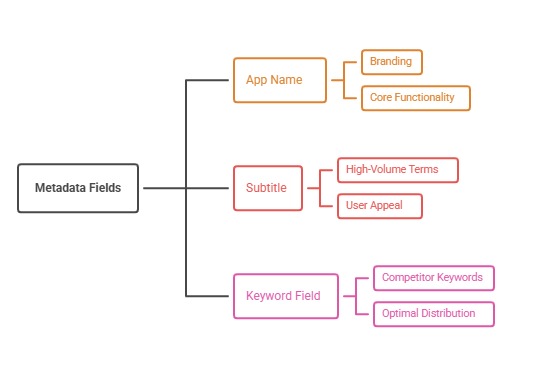
Finding long-tail keywords is only half the job. Placing them effectively requires understanding how each platform's search algorithm actually parses metadata. On iOS, Apple's hidden keyword field does not preserve exact phrases, it treats the field as a pool of individual words that get recombined, so long-tail phrases need to be broken into their component words and arranged so the algorithm can reassemble them into the intended combinations.
On Android, Google's indexing behaves more like traditional web search, matching semantic meaning across the full long description rather than a rigid keyword field. That means long-tail phrases can, and should, appear as natural, readable sentences rather than an unnatural stack of terms. This same principle underlies how Google's own SEO guidance for web content encourages writing for real readers first, with keywords supporting the sentence rather than replacing it.
A practical way to organize this work is to build a simple mapping table before writing a single word of metadata: list every long-tail phrase, note which platform it targets, and mark which specific field it belongs in. This forces a deliberate decision about where each phrase lives instead of cramming everything into the first available space, and it makes it far easier to spot when a field is being overloaded with too many overlapping terms at the expense of readability.
Balancing Long-Tail and Head Term Strategy
Long-tail keywords should not replace a head term strategy entirely. A well-rounded keyword plan usually includes a small number of realistic head terms your app has a genuine shot at ranking for, alongside a much larger pool of long-tail phrases that can be won faster and with less competition.
Think of it as a portfolio. Head terms are the long-term, higher-effort bets. Long-tail terms are the steady, compounding wins that keep organic traffic growing while you build the authority, reviews, and install base needed to eventually compete for the bigger terms. This mirrors the broader organic growth approach we cover in our guide to increasing app installs organically, where keyword breadth is one part of a much larger system.
Why Semantic Intent Makes Long-Tail Even More Valuable
App store search algorithms have moved well beyond simple exact-match keyword lookups. Both Apple and Google now weigh semantic relevance, meaning a listing can rank for a phrase it never explicitly contains if the surrounding context makes the connection clear. This shift, explored in depth in our articles on semantic intent in modern ASO and how semantic intent is redefining ASO, actually benefits long-tail strategy significantly.
When your metadata clearly communicates specific use cases, audiences, and problems solved, you naturally pick up long-tail visibility for phrases you never explicitly typed out, simply because the algorithm understands what your app is genuinely for.
Tracking Long-Tail Keyword Performance
Because individual long-tail keywords carry low volume, tracking them one at a time is inefficient. Instead, group them into thematic clusters, such as all use-case phrases, all audience-specific phrases, and all feature-comparison phrases, and monitor conversion and impression trends at the cluster level. This makes it far easier to spot which categories of long-tail phrasing are actually working and which need to be revised or replaced.
At ASOWin, we build these clusters directly into client reporting so that long-tail performance is visible alongside head term rankings, rather than buried in noise. When a cluster underperforms, we look at whether the issue is visibility, meaning the phrases are not appearing in metadata clearly enough, or conversion, meaning users are finding the listing but not installing. Those two failure modes require completely different fixes, and conflating them is one of the most common reasons long-tail strategies stall out after an initial round of changes.
Seasonal and trend-driven long-tail phrases deserve their own tracking cadence as well. A finance app might see a temporary spike in searches like "tax filing app" every spring, while a fitness app might see "workout plan" searches climb every January. Building a lightweight calendar of these predictable spikes lets you refresh relevant long-tail phrases ahead of time instead of reacting after the traffic window has already passed.
Final Answer: Building a Long-Tail Keyword Strategy That Compounds
Long-tail keywords are not a consolation prize for apps that cannot win broad terms. They are a deliberate, high-leverage strategy that compounds over time, converts well because it matches specific user intent, and can be won faster because competition is lower. Mining phrases from reviews, competitor gaps, and search suggestions, then placing them correctly for each platform's algorithm, is one of the most reliable ways to grow organic installs steadily.
For the complete picture of how keyword strategy fits into a full ASO program, see our App Store Optimization checklist for 2026, and explore more strategy guides on our blog. If you want a team to build and manage this process for you, ASOWin's keyword research and ranking strategy is built exactly for this kind of steady, compounding growth.