Introduction
Every ASO conversation eventually turns into a debate about tools. Which keyword tracker is most accurate. Which platform has the best volume estimates. Which dashboard should the team check every morning. It is an understandable instinct, but it skips the actual question that matters: what are you going to do with the data once you have it?
Keyword research tools for App Store Optimization fall into two broad categories: first-party data straight from Apple and Google, and third-party trackers built to estimate volume, difficulty, and competitor rankings at scale. Neither category is complete on its own. Apple and Google show you exactly what is happening on your own listing but say very little about the wider opportunity landscape. Third-party trackers show you the landscape but rely on estimation models rather than guaranteed platform data.
At ASOWin, we treat keyword tools as inputs into a process, not the process itself. This guide walks through the tools worth using, the metrics that actually matter, and how raw keyword data gets turned into a ranking strategy that shows up in real installs.
Short Answer: What Are the Best Keyword Research Tools for ASO?
The best keyword research tools for ASO combine first-party sources, Apple's App Store Connect search terms report and Google Play Console's search terms data, with third-party ranking and volume trackers that reveal competitor positioning and untapped opportunities. No single tool tells the whole story. What matters more than the tool itself is having a consistent process for prioritizing keywords, mapping them to metadata, and monitoring the results over time, which is exactly how ASOWin approaches every keyword installs engagement.
Why Keyword Research Still Decides Who Gets Found
Search remains the primary discovery path on both the Apple App Store and Google Play Store. Users type what they need, whether that is a category term like "budget tracker" or a specific brand comparison, and the store surfaces a ranked list of results. If your app is not visible on that list, it effectively does not exist for that user.
This is why keyword research sits at the very start of most ASO engagements. Get it wrong, and every later step, metadata writing, screenshot design, review strategy, ends up optimizing for the wrong audience. Get it right, and the rest of the funnel has a real chance to convert. Our keyword installs service exists precisely because durable organic growth is built on ranking for terms that real users actually search, not vanity terms that look good in a report.
First-Party Data Sources You Should Never Ignore
Before touching any paid tool, every ASO process should start with the data platforms give you for free. This data is tied directly to your own listing and reflects real user behavior, not a model's best guess.
Apple App Store Connect Search Terms
App Store Connect includes a search terms report showing which queries led users to view or install your app, along with impression and conversion figures. Because this comes straight from Apple, it is the most trustworthy signal available for iOS. It will not show every keyword you could rank for, only the ones already driving some traffic, but it is invaluable for understanding which of your current terms are actually working and which are dead weight.
Google Play Console Search Terms and Store Performance
Play Console offers a similar view under its store performance reporting, breaking down search terms by country and device type. Combined with store listing experiment results, this gives Android teams a clear picture of which keywords and which listing variants are converting best in each market. Because Android ranking leans more on the long description for keyword density, this data also helps validate whether your description copy is actually earning visibility for the phrases you intended.
Third-Party ASO Keyword Trackers and What They Add
Third-party keyword trackers fill the gap that first-party data cannot: visibility into keywords you do not yet rank for, competitor keyword overlap, estimated search popularity, and historical rank movement. These platforms use crawling and modeling to estimate volume and difficulty scores, which is useful for prioritization but should always be treated as directional rather than exact.
The real value of these trackers is comparative. They let you see how your app stacks up against three or four direct competitors across dozens of shared keywords at once, something that would take days to check manually inside the App Store or Play Store search bar one query at a time.
Most trackers also maintain historical rank charts, which matter more than a single snapshot. A keyword that has been slowly climbing for eight weeks tells a very different story than one that has been flat or falling, even if both show the same rank today. Trend direction is often a better prioritization signal than the raw current position, because it reflects whether your recent metadata or conversion changes are actually working, not just where you happen to sit on a given day.
Which Keyword Metrics Actually Matter
Not every metric a keyword tool surfaces deserves equal weight. Teams that chase the wrong numbers end up ranking well for terms nobody actually searches, or spending months trying to win positions for keywords with too much entrenched competition to realistically move.
- Search popularity or volume score: how frequently a term is searched relative to other keywords in the same category
- Difficulty or competition score: how hard it would be to break into the top results given current competitor strength
- Relevancy: whether the term genuinely reflects what your app does, not just a term with attractive volume
- Current ranking position: where you already sit, since small gains near the top of page one often drive more installs than large gains far down the list
- Opportunity score: a blend of volume, difficulty, and your current position that flags where effort is likely to pay off fastest
Relevancy deserves special attention because it is the metric most often ignored. Ranking first for a broad, high-volume term means little if the users who find you through it are not the users who convert or retain. This is the same shift our piece on semantic intent in ASO covers in more depth: exact keyword matches matter less than they used to, and matching genuine user intent matters more.
How to Read Competitor Keyword Data Without Copying Blindly
Competitor keyword analysis is one of the most useful features in any ASO tracker, but it is also the most misused. Teams frequently pull a competitor's full keyword list and try to replicate it wholesale, assuming that if a rival ranks for a term, they should too.
This ignores two important realities. First, a competitor may rank for a term because of brand strength, install history, or review volume that took years to build, not because their metadata is smarter. Second, not every keyword a competitor ranks for is relevant to your own app's actual feature set or audience. Copying blindly can dilute your listing's relevance and confuse the very algorithms you are trying to win over.
Instead, use competitor data to find gaps: terms with real search volume where no competitor has strong coverage, or long-tail phrases that a rival is missing entirely. That is often where the fastest wins are hiding, and it is a large part of why we wrote a dedicated guide to finding and ranking for long-tail keywords in app stores.
Turning Raw Keyword Data Into a Ranking Strategy
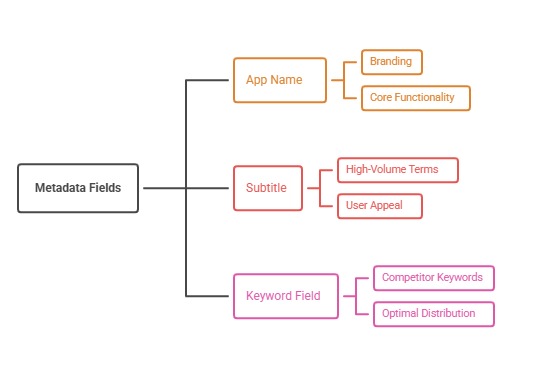
Data on its own does not move rankings. Once you have a prioritized keyword list, the next step is mapping each term to the right metadata field. On iOS, that means distributing terms across the app name, subtitle, and the 100-character hidden keyword field with almost no wasted characters or repeated words. On Android, it means weaving terms naturally into the title, short description, and long description without crossing into keyword stuffing, a line we cover in detail in our guide on keyword density in app descriptions.
This process mirrors the discipline paid search marketers already use. Similar to how advertisers rely on Google's keyword planning tools to translate raw search volume into a bidding strategy tied to actual buyer intent, ASO teams need to translate raw keyword scores into a metadata plan tied to actual conversion potential, not just visibility for its own sake.
Common Mistakes Teams Make With Keyword Tools
We see the same handful of mistakes repeatedly when auditing an app's keyword strategy for the first time.
- Chasing high-volume keywords that have little to do with the app's actual purpose, which hurts relevance signals over time
- Treating a single tool's difficulty score as an exact number rather than a rough estimate to be cross-checked
- Ignoring country and language differences, and applying one keyword set globally instead of localizing for each market
- Setting a keyword list once at launch and never revisiting it as competitors update their own listings
- Failing to connect keyword changes back to actual impression and conversion data after an update ships
Each of these mistakes is fixable with a more disciplined process, which is usually the real gap, not a missing tool. A tool can surface a hundred keyword ideas in seconds, but it cannot tell you which ten are worth building your metadata around, and it will not flag when your app's category has shifted enough that last quarter's priority list no longer reflects how users are actually searching today.
It also helps to separate short-term tactical fixes from longer-term keyword bets. Some terms are worth targeting immediately because competition is low and relevance is high. Others are worth tracking for months while your app builds the review volume, install base, or feature set needed to realistically compete for them. Treating every keyword opportunity as equally urgent is one of the fastest ways to burn a team's time on the wrong priorities.
How ASOWin Builds a Keyword Strategy From Tool Data
At ASOWin, our keyword research process starts with a full audit of current rankings across both the App Store and Play Store, cross-referenced against three to five direct competitors. From there, we build a prioritized keyword map scored on relevance, opportunity, and current position, then translate that map directly into metadata recommendations for each platform's specific fields.
We do not stop at the initial rollout. Rankings and conversion data get monitored on an ongoing basis, and the keyword list gets refreshed as search behavior shifts, competitors update their listings, or new features change what your app can legitimately rank for. This is the same full-cycle approach described in our guide to full-cycle ASO from keyword research to conversion, where keyword strategy is treated as one connected system rather than a series of disconnected updates.
Final Answer: Choosing and Using Keyword Research Tools
There is no single best keyword research tool for ASO. The strongest approach combines Apple's and Google's own first-party reporting with third-party trackers for competitor visibility, filtered through a clear framework for what actually matters: relevance, realistic opportunity, and conversion, not just volume. For a broader view of how keyword work fits into the rest of your optimization roadmap, our App Store Optimization checklist for 2026 lays out the full picture step by step.
If you are ready to turn keyword data into a ranking strategy instead of a spreadsheet nobody revisits, ASOWin's team can build and run that process for you. You can also browse more research and strategy breakdowns on our blog.