Introduction
The United States is one of the largest and most competitive app markets in the world. That combination, size and competitiveness, is exactly why so many apps that succeed in other regions struggle to gain traction once they enter the US App Store and Google Play landscape. Category leaders in the US are typically well-funded, aggressively tested, and deeply optimized. Winning visibility here takes more than a translated listing and a generic keyword list.
At ASOWin, our US-focused ASO services are built around the specific realities of this market: an iOS-first premium user base, high category saturation, demanding review and rating expectations, and consumers who compare apps quickly before committing to an install. This guide walks through why US apps need a locally calibrated ASO approach and what that approach actually looks like in practice.
We work with US brands ranging from established enterprises expanding their mobile footprint to venture-backed startups launching their first app, and the pattern is consistent across both: teams that treat ASO as a US-specific discipline, rather than a global checklist applied uniformly, consistently see stronger rankings, better conversion, and healthier long-term retention than teams that do not.
Short Answer: Why Do US Apps Need Local ASO Expertise?
US apps compete in one of the most saturated app markets globally, where category leaders invest heavily in keyword optimization, creative testing, and reputation management. A local ASO approach matters because American users respond to specific signals, ratings, review recency, iOS-first design conventions, and clear value communication, that differ from what converts well in other regions. An agency with direct US market experience, like ASOWin, can calibrate strategy to these specific behaviors rather than applying a one-size-fits-all global template.
How Competitive Is the US App Store Market?
Almost every major app category in the United States, from finance and health to productivity and gaming, has multiple well-established, well-funded incumbents actively defending their keyword rankings and category positions. New entrants face a market where the baseline bar for screenshots, app icon design, review response quality, and metadata precision is already high.
This competitiveness means keyword difficulty in the US tends to run higher than in many other markets. Ranking for broad, high-volume terms often requires sustained install velocity and strong conversion signals over time, not a one-time metadata update. Apps entering this market need a strategy built for the long game, not a quick keyword swap.
New entrants often underestimate just how much incumbents in their category have already invested in continuous testing. A category leader in the US market may be running dozens of screenshot and icon variants per year, iterating constantly based on live conversion data. Competing against that level of ongoing optimization requires a similar commitment to iteration, not a single well-crafted launch listing left untouched afterward.
Why iOS-First Strategy Matters in the US
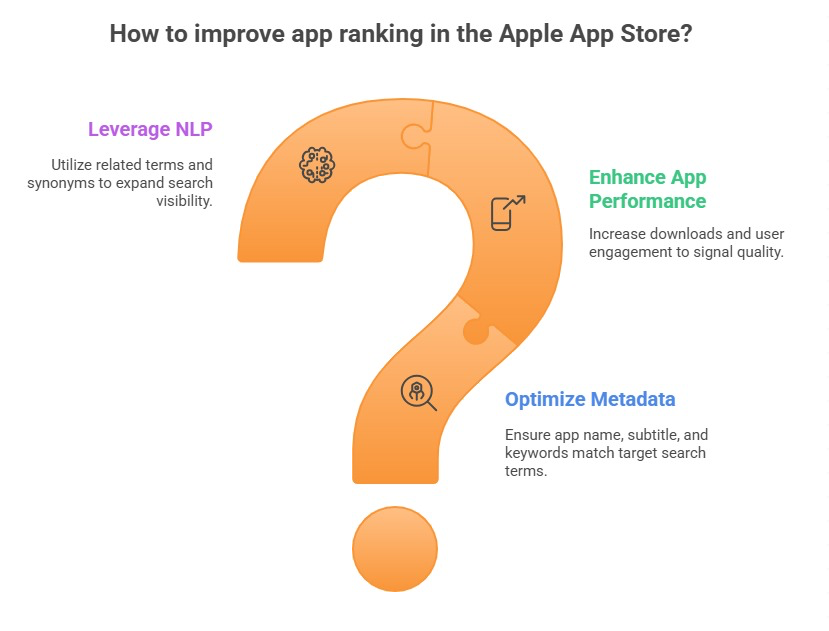
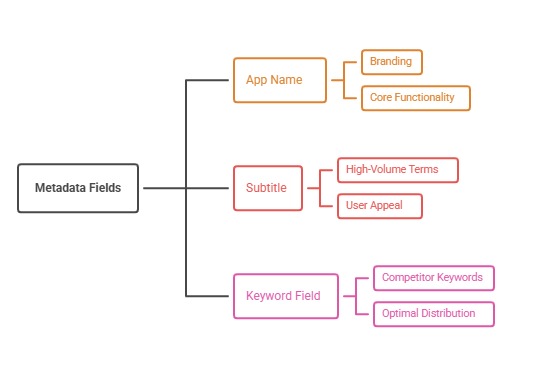
Unlike many global markets where Android holds a dominant device share, the iPhone commands a substantially larger share of the US smartphone market than the global average. This shifts the balance of ASO priority. Apple App Store elements, including the title, subtitle, the hidden keyword field, screenshots, and App Store Search Ads, deserve proportionally more attention for apps targeting American users than they might in an Android-dominant market.
Apple's own Product Page Optimization documentation outlines how developers can test different screenshots, previews, and icons against live App Store traffic, a capability that is especially valuable in a market as competitive as the US, where marginal conversion gains compound quickly across high search volume.
That said, Google Play still represents a meaningful share of the US Android install base, and apps that ignore it entirely leave real growth on the table. The right approach treats both platforms seriously, weighted according to where the target audience actually is.
Apple Search Ads deserves particular attention in this context, since it lets brands secure prominent search placement for keywords they may not yet rank for organically, which is often useful during the early months of a US launch while organic rankings are still building. Used well, paid search placement and organic ASO work together rather than as competing priorities, a balance we cover in more depth in our broader look at how to balance paid and organic user acquisition.
US Consumer Expectations Around Reviews and Ratings
American app store users are notably influenced by star ratings and recent review content before installing. A strong average rating with a thin or stale review history converts worse than a strong rating backed by frequent, recent, substantive reviews. US users also expect brands to respond to negative reviews professionally and promptly, treating developer responses as a proxy for how a company treats its customers generally.
- Recent review volume and sentiment carry significant weight in conversion decisions
- Developer responses to negative reviews are closely watched and influence trust
- Rating trends, not just the current average, affect how new users perceive an app
- Review prompts need careful timing to avoid frustrating users at the wrong moment in the journey
Apps that neglect active reputation management in the US market frequently see conversion suffer even when their underlying product quality is strong. This is particularly true in categories where trust is directly tied to the core product experience, such as finance, health, and any app handling sensitive personal data, where a handful of unanswered negative reviews can outweigh dozens of positive ones in a potential user's mind.
Keyword Research Calibrated to American Search Behavior
Keyword research for the US market cannot simply reuse a global keyword list. American users search with different phrasing, different colloquialisms, and different intent patterns than users in other English-speaking markets, let alone non-English markets. Effective US keyword strategy accounts for regional spelling conventions, common American product terminology, and the specific competitive keyword landscape within each app category.
This is where the broader principles covered in our guide to choosing the best ASO agency for app growth apply directly. An agency without real US market experience will often miss these nuances, leading to keyword targeting that looks reasonable on paper but underperforms against the actual search patterns of American users.
Seasonal and cultural timing also plays a bigger role in the US than many international teams expect. Search behavior shifts around major American holidays, back-to-school periods, and tax season in ways that a team unfamiliar with the local calendar can easily miss, leading to missed opportunities for keyword and creative updates timed to when demand is naturally highest.
Creative and Messaging Conventions That Convert in the US
US app store creative tends to reward clear, benefit-led messaging over abstract branding, along with screenshots that quickly demonstrate core functionality within the first two or three frames. Users scroll quickly and make install decisions in seconds, meaning the first screenshot in particular needs to carry the bulk of the persuasive weight.
Localization here is not about translating language, since the primary market is English-speaking, but about localizing tone, cultural references, pricing display conventions, and trust signals like well-known payment methods or security certifications that resonate with American users specifically.
It is also worth remembering that the United States is not linguistically homogeneous either. A meaningful share of US mobile users are Spanish-speaking or bilingual, and apps in categories like finance, retail, and healthcare often see measurable conversion gains from offering a Spanish-language store listing variant alongside the primary English one, rather than assuming English-only coverage is sufficient for the entire American market.
Why Fortune 500 and Enterprise Apps Face Extra Scrutiny
Large US enterprises and well-known consumer brands entering or expanding in the app stores face a different challenge: high user expectations tied to brand reputation, along with intense scrutiny from existing customers who compare the app experience directly against the brand's other digital properties. Falling short on store presence can actively damage brand perception, not just app performance.
We explore this dynamic in depth in our guide on why Fortune 500 companies need a dedicated ASO agency, and the same logic applies broadly to any established US brand launching or scaling a mobile app.
Even outside the Fortune 500, mid-market and venture-backed US brands face a version of the same pressure. Users increasingly expect a consistent, polished experience across web, email, and mobile app touchpoints from any company they already trust, and a weak or neglected app store presence can quietly undercut brand credibility built through every other channel.
Balancing Paid and Organic Growth in a High-CPI Market
Cost per install in the United States tends to run higher than in many emerging markets, simply due to the intensity of competition for user attention. This makes organic ASO performance disproportionately valuable in the US, since every organic install effectively offsets what would otherwise be an expensive paid acquisition cost. Apps that build strong organic rankings in the US market gain a real structural cost advantage over competitors leaning almost entirely on paid channels.
This is precisely why we encourage US-focused clients to view ASO investment as a hedge against rising paid acquisition costs rather than a nice-to-have addition. As auction dynamics push cost per install higher across nearly every category, the apps with the strongest organic rankings are the ones best positioned to keep blended acquisition costs manageable over time.
How ASOWin Approaches the US Market
At ASOWin, our US strategy combines iOS-weighted metadata and keyword research, proactive review and rating management, conversion-focused creative testing, and coordinated paid acquisition planning, all calibrated specifically to how American users search, compare, and decide. We do not apply a generic global playbook to US clients. We build strategy around the actual competitive dynamics of this specific market.
That approach extends to how we report results as well. Rather than presenting generic global benchmarks, we track performance against category-specific baselines within the US market itself, since what counts as a strong conversion rate or ranking position in US fintech looks very different from what counts as strong in US gaming or US productivity software.
For teams building a broader ASO foundation before layering on US-specific tactics, our App Store Optimization checklist for 2026 is a useful starting point, and comparing strategies across regions can be helpful too; see our guides to ASO for the Indian app market and ASO for the Indonesian app market for contrast with two very differently structured markets.
Final Answer: Conclusion
US apps compete in a market where category leaders are well-optimized, user expectations around reviews and ratings run high, and iOS carries outsized importance relative to many other regions. Succeeding here requires ASO strategy that is calibrated specifically to these dynamics rather than borrowed from a generic global template.
At ASOWin, we help US-focused apps build that calibrated strategy, from keyword research to reputation management to paid and organic coordination. Explore more growth strategy on the ASOWin blog, or reach out if you are ready to build a US market strategy suited to how American users actually discover and evaluate apps.